

stud·y group
plural study groups
noun
When students come together to work in a small group to achieve a common goal. Study groups can be one of the most effective methods of studying. Here are some ideas about how to effectively set up and use a group study session.
Study group setup
Connecting with others
There are a lot of ways to ask people to form a study group, but “Are you in a study group yet? I was thinking of starting one” might be your easiest entry point. Ask in class or lab or recitation, or post your invite on Canvas. Nervous to ask? Remember that most people think it’s awkward to ask, but chances are they’ll be grateful to you for asking first and for getting a study group started.
Q: Is it better to study with friends or with people you don’t know?
A: That’s up to you! Try it both ways, and see what works.
Q: How big or small should a study group be?
A: A study “group” can be as small as two people. When they get too big they can be hard to organize, and if you’re taking turns practicing, large groups mean less practice time for each person. We recommend capping the group size at 5–6 people. If more people join, break out into smaller groups.
Identify your purpose
Study groups can be structured to accomplish different things. Some groups meet weekly to review the material for that week, while others are focused on doing practice problems or studying for exams. Here are some examples of different purposes that study groups have:
-
Discuss and review content each week
-
Quiz each other in preparation for an exam or test
-
Brainstorm ideas for papers or projects
-
Work through difficult problems for lab or homework
Determining the purpose of your study group isn’t necessary before you create a group, but it can help you figure out the size of your group, what an ideal study space is, how often to connect, and it’ll ensure you have the same idea about how you’ll spend your time.
Arrange logistics
Set a location that meets your needs. A study room in the library? An empty classroom? A study space in the building where your class meets? Be sure to minimize distractions and choose a neutral space everyone can access. Looking to work online? Some study groups meet together online through Zoom or Teams, or they work asynchronously using tools like Quizlet or Google Docs to compile study guides or draft practice tests. Others create a group text, group chat on Instagram, or a Discord for questions.
Scheduling & timing
Schedule your study group to align with the purpose you identified. While we recommend meeting weekly to discuss material from that week and to stay caught up on content, you may also choose to stack meetings closer to midterms, exams, or projects, or schedule one-time meetings to answer questions or get unstuck. Regardless of your frequency, it can be helpful to get on the same page about how you’ll time the session and how long you each commit to being there. If you’re planning to meet for 2-3 hours, plan to take a few breaks, too.
Ask instructors first!
Before you start a study group, check in with your professor and clarify their expectations regarding study groups. What types of assignments are okay to work on together? What do they expect you to work on individually? For example, some professors may encourage you to practice together for an exam, but those same professors may also expect lab reports to be completed independently.
Develop expectations for working together
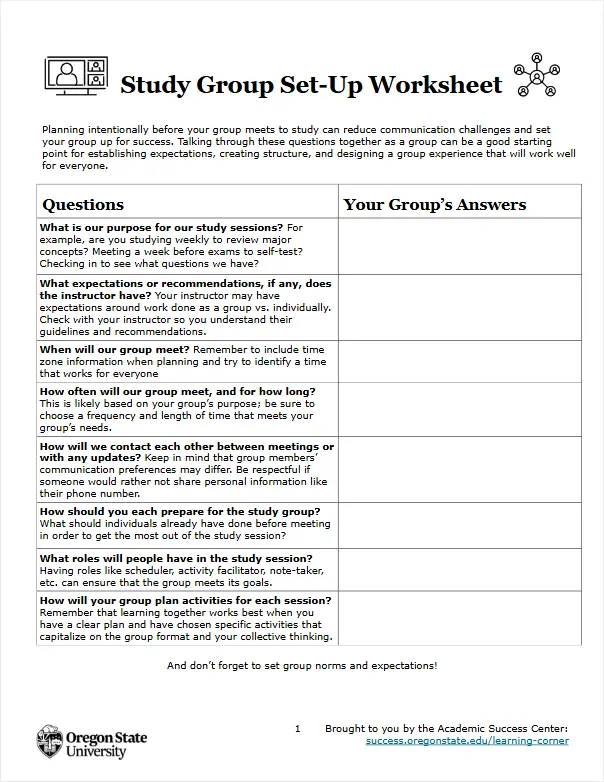
Ask a few quick questions to set expectations and prevent common collaboration challenges before they show up. For example, try asking...
- What should each person do to prepare for meetings?
- What will we do if we get off track?
- Do we want a scheduler? A facilitator? (If so, consider rotating.)
- How will we contact each other outside of meetings?
- What else should we discuss before we get started?
Check out our Study Group Setup worksheet for more ideas on establishing expectations, creating structure, and designing a group experience that will work well
for everyone.
Effective use of time
Set a goal and design your time
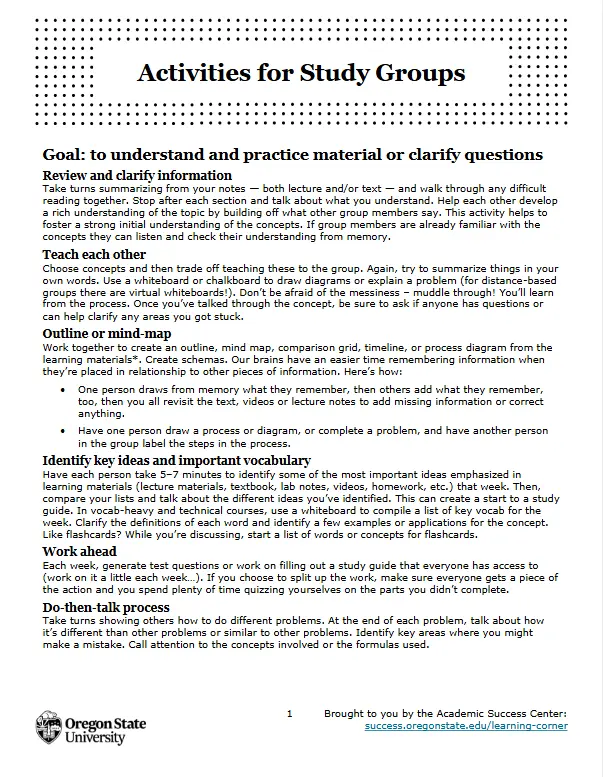
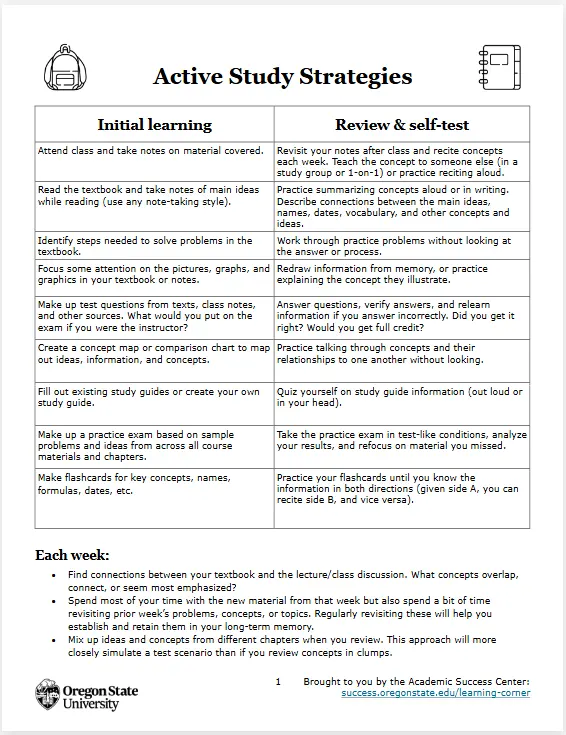
Spend 5-10 minutes designing your time together. What’s most important? What would you do last in case you run out of time? For example, “I want to study for the test together” is an intention, but because it lacks a specific plan, it can keep a group from being productive. Instead, try, “I want to create a study guide over chapters 4 & 5,” or, “We could do practice problems from unit 3 for 45 minutes, take a break, and then do practice problems from units 1 and 2 to review for the last 30 minutes.” You’ll be set up for success if you can identify what you want to accomplish, what activities will help you accomplish that goal, and how much time you’ll spend on each activity. Here’s a list of Study Group Activities, and check out Active Study Strategies and Self-Testing Strategies for more example activities.
Learn together and use effective study strategies
Learning happens when each person has a chance to work actively with the material you’re learning. While explaining a concept to someone else is a great activity, effective study groups optimize the session with active study strategies and taking turns to make sure everyone gets a chance to practice.
Take turns actively doing the work
Instead of defaulting to one person, rotate who answers questions, works problems, or explains concepts. This helps everyone practice. Even if you’re not feeling sure, it’s a chance to test out what you do know.
- Practice putting concepts into your own words, even if your explanation feels incomplete. It’s okay to not feel confident; study groups are a place to work through ideas together. Once you’ve answered, the group can discuss it further.
- Pick a problem and give each person a chance to solve the problem or answer the question independently and then discuss.
- If you’re taking turns and someone else is answering a question, practice in your head as well to see if you know the answer, then compare.
- Share the confusion and mistakes. It can be common to want to bury mistakes, but actually pointing them out to can help others avoid them in the future. “I got that wrong because I transposed those concepts. I’ll bet that’s something we should pay attention to.”
Build rapport as a group
- Create positive accountability: help the group realize when you need to practice more: “We relied heavily on the textbook. Let’s try it again on our own.”
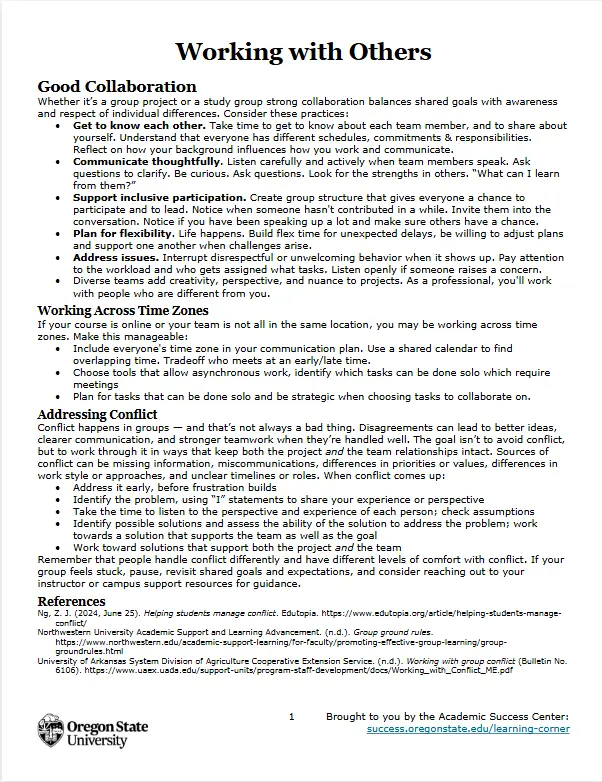
- Don’t think of disagreement as a problem, but frame it as an opportunity to deepen understanding through discussion, clarification, and resource consultation
- Use validation to encourage one another: “I was confused about that also” or “I see where you’re going – can I add on to that?”
- Provide encouragement to normalize working through challenge or uncertainty: “Take your time” or “It doesn’t have to be perfect – we’re just brainstorming” or “You can start the problem, and we’ll help out if you get stuck.”
Plan next steps before you end
When you’ve reached your stopping point, there are some final steps that will set you up for success when you meet again. It can be hard to stop the momentum, so you might have a time-keeper with this role, ready to cut the group off with 10 minutes to go and redirect the group towards these planning steps.
- Take stock of what you accomplished, identify where you left off so you can continue at the next session or on your own.
- Talk about what worked well as a group and what you might improve for next time.
- Decide when you’ll meet next and what the purpose of that session will be.

Apps and tools
Study groups work well when you’ve got tools to help you meet, communicate and stay organized. The tools below support study group and group project activities. Some are already supported by OSU and most have a free version available:
-
Hold your meeting online: Zoom (Available via OSU), Microsoft Teams (Available via OSU), Google Meet
-
Set up a chat or message group: group text, OSU email, WhatsApp, Discord, Slack
-
Use task and project management software to stay organized: Trello, Asana, Notion, Google docs
-
Use an app for scheduling: Doodle, When 2 Meet, Calendly
-
Build collaborative documents: Microsoft Word/Excel/PPT online (Available via OSU), Google Docs/Sheets/Slides
-
Create a file-sharing area: Box (Available via OSU), Microsoft OneDrive (Available via OSU)
-
Use quiz, flashcard, and other study tools together: Quizlet, Anki, Kahoot
Frequently asked questions
If it’s you… try to hold back. If it’s someone else, suggest a process: “Let’s each take turns answering a problem so everyone gets a chance.”
Look through your resources. If you're still stuck, talk through what you each know. Make a plan for who will contact the TA or instructor.
They benefit from your knowledge! But don’t dominate. If it's too frustrating, seek out another study group.
They benefit from your questions. Speak up and participate. If it's too frustrating, find another group.
Try a gentle nudge: “Let’s get back to studying”. If it’s a pattern, point to that: “I notice we keep talking about weekend plans. Let’s get through [this much], and then we can take a break and chat.” If it continues, you can share your frustration and revisit the group agreements. If still unsuccessful, you may need to consider a different group with others who have your same approach.
Group projects are different than study groups, but a lot of this information applies to both contexts. Check out more information in our Group Project Collection.
References
Case Western Reserve University. (n.d.). Study group strategies.
Doctors in Training. (n.d.). Suggested member roles and activities for an effective study group.
Forrest, K., & Miller, R. (2003). Not another group project: Why good teachers should care about bad group experiences. Teaching of Psychology, 30, 244-246.
Magoosh. (2014). Creating a productive group study session. https://magoosh.com/hs/sat/sat-study-tips/2014/creating-a-productive-group-study-session/
Maloof, J., & White, V. (2005). Team study training in the college biology laboratory. Journal of Biological Education, 39(3), 120-124.
MIT (2014). Tutoring options: Formal study groups.
Phipps, M., Phipps, C., Kask, S., & Higgins, S. (2001). University Students' Perceptions of Cooperative Learning: Implications for Administrators and Instructors. Journal Of Experiential Education, 24(1), 14.
Rybczynski, S., & Schussler, E. (2011). Student Use of Out-of-Class Study Groups in an Introductory Undergraduate Biology Course. Cbe-Life Sciences Education, 10(1), 74-82.
Sawyer, & Berson. (2004). Study group discourse: How external representations affect collaborative conversation. Linguistics and Education, 15(4), 387-412.
Supplemental Instruction leader’s guide: Peer-assisted study sessions. (2012). Corvallis, OR: Oregon State University.
UC Berkeley (2014). Using groups in classes & encouraging study groups.